
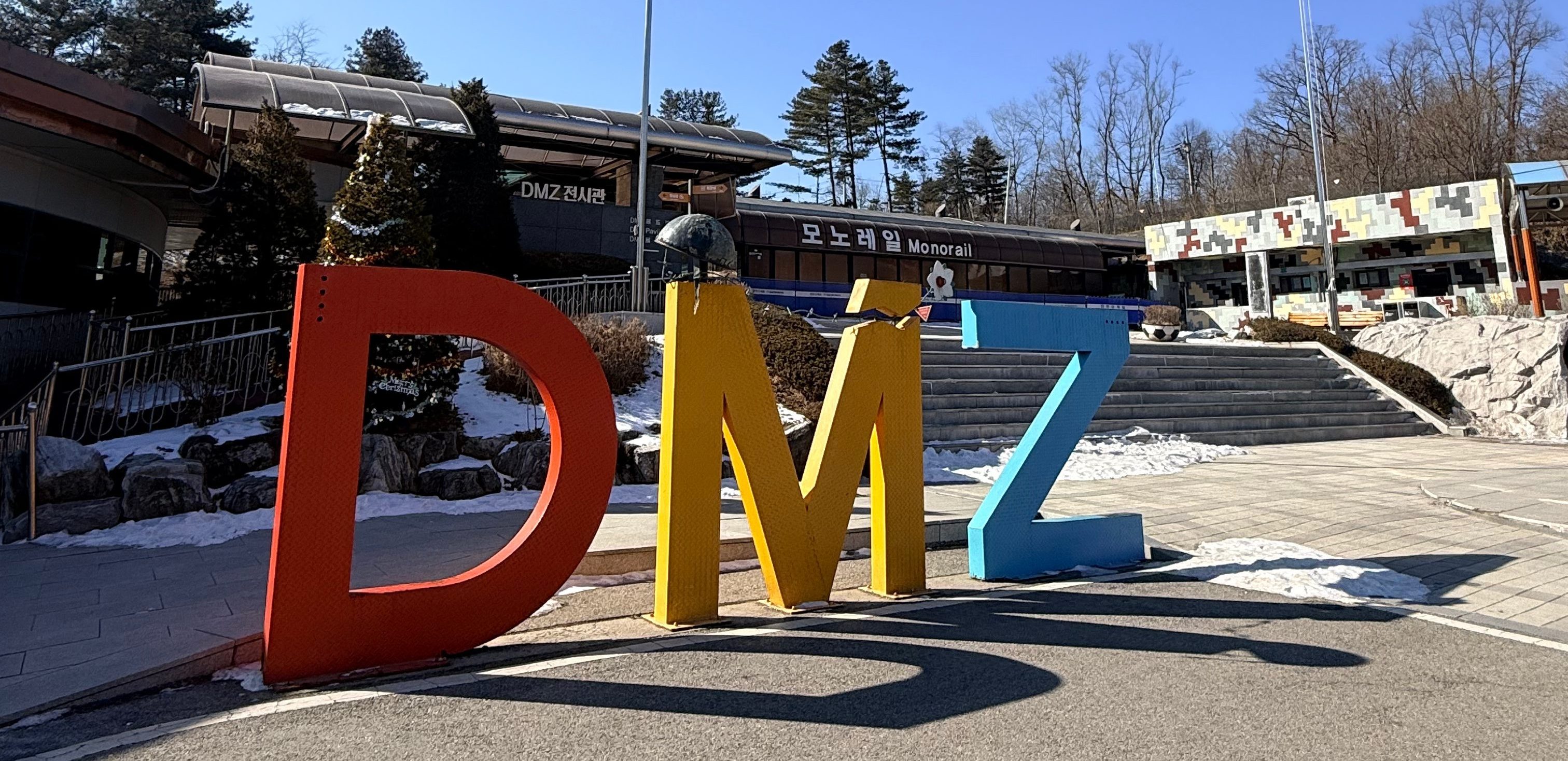
Seoul is a fabulous city; there are so many things to see and do that it’s easy for your itinerary to fill up quick. However, Seoul is also close to many other attractions that can help you understand the long and colourful story of South Korea.
When visiting Seoul in January 2026, I went on a day trip to the Demilitarized Zone (DMZ) and Mt. Gamaksan Suspension Bridge. The experience was very unique and eye opening, and something I believe is a must when visiting South Korea. This article is an overview of the itinerary and review of my experience. But before jumping into the details of the tour, I feel it’s important to talk about what the DMZ is and how it came to be.
What is the DMZ?
The Demilitarized Zone is a 4km wide and 250km long stretch of buffer land that divides North and South Korea. Born out of the Korean war and established in 1953, it’s one of the world’s most heavily militarized borders, and the frontline of the ongoing conflict in Korea.
The area is broken into five key lines which are important to understand as tours will take you to a few key places:
- Demilitarized Zone (DMZ): a 4km wide strip of land (2km either side of the DML) where military, weapons, and civilian personnel are prohibited to enter.
- Military Demarcation Line (DML) – the actual land boarder dividing North and South Korean, running through the centre of the DMZ.
- Southern Limit Line (SLL): the barbed wire fence marking the southern boundary of the DMZ (South Korean edge).
- Northern Limit Line (NLL): the disputed maritime boarder in the Yellow Sea, acting as the de-facto sea boarder between North and South Korea.
- Civilian Control Line (CCL): a buffer zone extending up to 10km south of the DMZ, creating a restricted zone where civilians need authorization to enter.
Due to the lack of human activity in the DMZ for decades, the zone has become an unintentional nature sanctuary. Rare wildlife, such as the red-crowned cane and amur leopard, have been spotted in the area.
Crossing into the DMZ
After being picked up from the Myeongdong district in Seoul, the bus took us on a 45 minute drive to the CCL. Our tour guides (Anna and Kenny) were very informative along the journey discussing the history of the Korean War, the political regimes that dominate either side today, and the toll taken on the general public over the course of conflict.
The CCL checkpoint is a mandatory stop for anyone wanting to cross into the area. It’s important to be aware that during the stop South Korean soldiers will board your tour bus to check your passport. Whilst it seems scary, it’s a simple security measure so there’s no need to worry as long as you have your ID.


Dora Observatory
Our first stop after passing into the CLL was the Dora Observatory. The staff were great in teaching us more about the DMZ, and telling interesting (but sad) stories of people who had tried to cross. Before heading out onto the open air lookout deck, they also gave us a rundown of the different buildings and towns that can be seen over the boarder. This included the enormous North Korea flag tower which is the tallest flagpole in the world; erected at 160m high purely to outdo the 98m one on the South Korea side.
It was so strange looking through the binoculars into North Korea. It was even more unnerving knowing there are guard towers watching you, and fake towns created to convey a false sense of what life is like over the boarder. Recent law changes have mandated that no photos can be taken of Dora Observatory, and strictly no filming or photography is allowed of North Korea.

We were reminded by our guides many times that photography is illegal, and that the guard towers on the North Korean side (photo on the right below) are constantly monitoring visitors from afar. I saw many tourists try to sneak photos, resulting in the staff removing them from the building. With a $10,000 AUD fine and 1 year in prison as a penalty, I really don’t think the risk of taking a photo is worth it. The images above and below were sent to us by our tour guides, captured when photography was legal.


The Third Tunnel
Third Tunnel is the largest of four infiltration tunnels built in secret by North Korea. Discovered in 1978, the tunnels were constructed to support a surprise attack on Seoul. Capable of moving up to 30,000 soldiers per hour, the tunnel is approximately 1.6km long, 2m wide and 2m high.
Leaving Dora Observatory we drove 10 minutes back down the mountain to the Third Tunnel. After a short but highly informative museum exhibition detailing the tunnels discovery, we grabbed our hard hats and ventured underground. What makes the experience one of a kind is that you actually walk underneath the South Korean side of the DMZ and right up to the Demarcation Line (DML); an area that can’t be accessed above ground. *No photography was allowed so the only picture I have to share is the entry sign.

I will pre-warn anyone wanting to go inside the tunnels that they can be physically demanding, and that’s coming from a reasonably fit 30 something year old. First we walked down a steep incline 350m in length, which keep in mind you have to walk back up. After this there is another 300m tunnel to a concrete barricade which marks the DML. As a 5ft 11in (ish) person, the last part of the tunnel was the hardest as I was too tall and had to do a constant squat walk to get to the end.
I find it difficult to describe my feelings upon seeing the concrete barrier at the end of the tunnel. Knowing you can’t access the DML above ground, it was a strange feeling to suddenly be facing a wall the other side of which was North Korea. It was and still is the source of so much pain for so many people, the likes of which I hope to never experience. To say that I was surprised, sad and a little unnerved is an understatement; particularly when our guide revealed there are over 2 million active landmines in the ground above us. While a little nervous at the time, I’m glad I did it.
Paju’s Unification Village
After the Third Tunnel we went to Paju’s Unification Village; a unique place to visit as it is one of the few towns located north of the CCL. Home to mostly farmers, the village is well known for it’s high quality agricultural products like Jangdan soybeans and rice. Our short 15 minute stop in the town was at the local markets where you can shop a range of locally produced items (soybean ice cream, liquor, skincare, vegetables etc). I bought moisturiser made from snail mucen, because why not? As the usual visitors to the markets are soldiers, there is no tax and discounts are heavily applied to all products. After paying $50 for my moisturiser I jumped on Amazon and learnt that normally it retails for $150! Should have filled up my suitcase.
Fun fact: each house in Unification Village has a flagpole in the front yard. It’s mandatory every morning for residents to raise their South Korean flag, and take it down at the end of each day. If someone doesn’t raise their flag in the morning, soldiers will knock on their door to check no ones been been kidnapped or harmed by invading troops.
Imjingak Peace Park
Our final stop on the DMZ part of the trip was Imjingak Peace Park. Built in 1972, the park sits on the edge of the Imjin river and was created to console those from both sides of Korea who are unable to return to their homes.
Scattered around the park are numerous monuments dedicated to the civilians and military personnel who have lost their lives, and the families still affected by the ongoing war. Freedom Bridge is located in Imjingak, and is where over 12,000 Korean war prisoners returned home after the ceasefire was called in 1953.


One of the monuments in Imjingak is a rusted train with over 1,000 bullet holes. It used to run the rail line between Seoul and Sinuiku on the North Korean boarder. After it was bombed in the war, the train was left in the DMZ for more than half a century.
It was eventually rescued from the DMZ and brought to the peace park. During removal, the team also brought back the tree that had grown through the carriage’s centre. As the tree is entwined with the train’s story, they remain side-by-side in Imjingak.
There are also many restaurants and shops to browse in the park. After wandering around the monuments we grabbed a bite to eat before heading to Mt. Gamaksan.
Mt. Gamaksan Suspension Bridge
The last stop of the day was the Suspension Bridge at Mt. Gamaksan. Gamaksan is one of the 5 great mountains of the Gyeonggi area, and the 150m long suspension bridge connects the Gamaksan trail to Seolmari Valley. Walking across the bridge you have beautiful views of the surrounding forest, and if you look closely you can find a few small temples dotting the mountain ridges.

After crossing and walking another 200-ish metres along the wooden boardwalks, we got to see Gamaksan’s signature waterfall, Ungyepokpo. As I visited South Korea in January, during the height of winter, the near vertical waterfall was completely frozen. Our guide informed us that Ungyepokpo is an important place for Feng Shui, an ancient Chinese artform that optimises the flow of life to harmonise with nature. I was told that if you visit the waterfall in January your year ahead will be filled with prosperity and balance. Learning what was in-store for us in 2026 was the perfect end to the day.


Final Thoughts
Nothing paints a picture of Korea’s sad conflicting military past like the DMZ. Seeing the area really opened my eyes to all the tragic and despicable stories of families separated and lives lost. Learning about these events both when in school and through a computer screen does not do justice in conveying the ongoing tension. Seeing the military forces first hand really puts the unending story into perspective. Even the landscape was barren, dry and lacking the beauty of South Korea’s natural environment, visually reinforcing the tension of the area.
I strongly recommend that anyone visiting South Korea jumps on one of these tours; you really can’t get the full view of the country’s past and present without going and seeing the DMZ for yourself.
Tour Details
Vendor: Booked through Get Your Guide and operated by I Love Seoul.
Tour link: https://www.getyourguide.com/seoul-l197/seoul-dmz-the-3rd-tunnel-and-suspension-bridge-tour-t63309/
Duration: 9 hours
Cost: $85 AUD
Read More About Asia


Get in Touch!
If you have any questions or would like additional recommendations, then we would love to hear from you! Please reach out and send us an email.


Leave a Reply